Best Dog Collars UK: A Guide for Every Dog
Almost all dogs in the UK need to wear a collar. The Control of Dogs Order 1992 requires a dog, while on a highway or in a “place of public resort”, to wear a collar bearing the owner’s name and address, either on the collar or on an attached plate or badge. Beyond the legal requirement, a well-chosen collar also affects your dog's comfort, your control on the lead, and how well the collar holds up to British weather and daily use.
Browse the full dog collar range see the complete EzyDog range, or read on for a practical guide to which collar suits your dog and why.
What to Think About Before Choosing a Dog Collar
The right collar depends on three things: your dog's size and build, their daily lifestyle, and the conditions you walk in. Most UK dog owners end up with more than one collar over a dog's life: a lightweight everyday option, a more hardwearing version for active or wet walks, and sometimes a specific design for training. Understanding which type does what makes the choice considerably easier.
UK law and ID tags
Every collar needs a securely attached ID tag showing your name and address. A phone number is strongly recommended. This is a legal requirement and applies even if your dog is microchipped. Make sure any collar you choose has a robust D-ring that holds an ID tag securely, a D-ring that bends or comes loose under the weight of a tag is not fit for purpose.
Fit above everything
A poorly fitted collar causes more problems than a cheaper material. The standard fitting rule applies across all collar types: you should be able to slide two fingers, laid flat, between the collar and your dog's neck. Any tighter and it restricts breathing and causes pressure sores. Any looser and it can slip off.
Check the fit regularly. Puppies grow fast. Adult dogs gain and lose weight seasonally or with age. A collar that fitted correctly six months ago may need adjusting now.
The EzyDog Collar Range: Which One Suits Your Dog
1. Neo Classic Collar
The Neo Classic Collar is EzyDog's most robust everyday collar and the one we reach for first for most UK dogs. It is made from high-grade neoprene, the same material used in wetsuits which makes it fully waterproof, quick-drying, and odour-resistant after wet or muddy walks.

For a country that averages well over 100 rainy days a year, a collar that does not hold moisture, does not smell after a muddy field walk, and dries quickly between outings is a practical advantage rather than a luxury. The neoprene padding is durable for all-day wear compared to a standard flat webbing collar.
The Neo Classic suits dogs of all sizes and comes in a range of colours. The woven reflective piping improves visibility on early morning and evening walks, useful throughout the year and particularly so in autumn and winter when daylight walks are not always possible.
It is the everyday collar for dogs that swim, play in streams, walk through wet grass, or simply live somewhere that sees regular rain.
Best for:
Active dogs, water-loving dogs, everyday all-weather wear, dogs that spend time outdoors in variable UK conditions.
Browse reflective dog collars if low-light visibility is a priority for your walks.
2. Double Up Collar
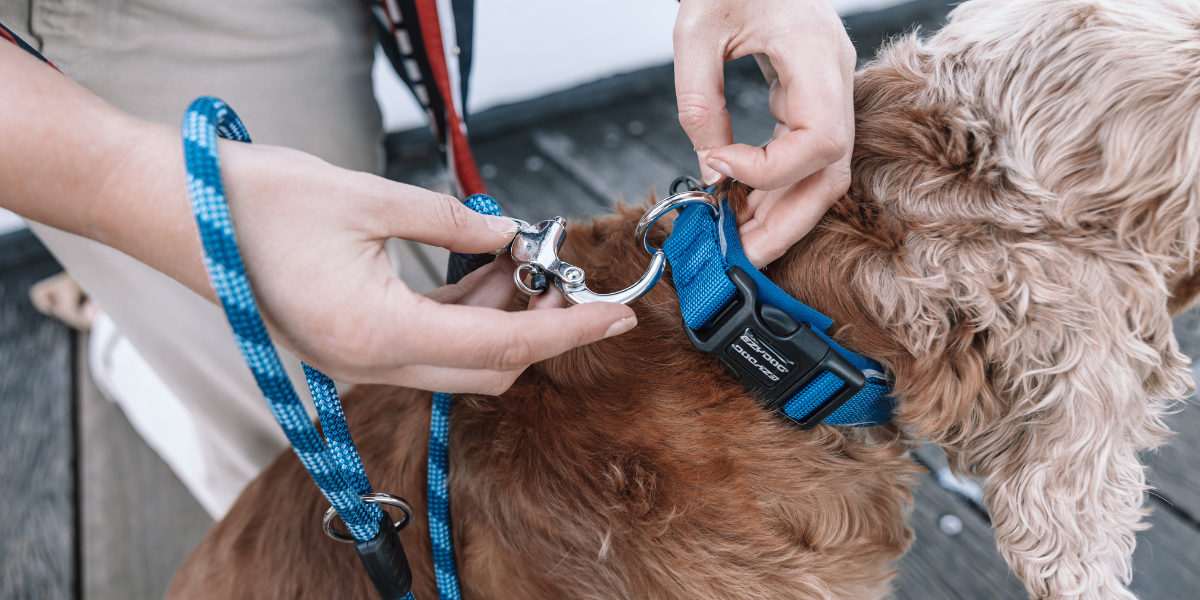
The Double Up Collar is built for dogs that put more stress on their collar than average. It features two stainless steel D-rings rather than one. When you clip your lead to both rings simultaneously, the pull force bypasses the buckle and distributes across the collar body instead, making the connection between lead and collar considerably more secure.

This matters most for larger or stronger dogs, particularly those that pull occasionally or lunge unexpectedly. A single D-ring collar under sustained force can work the buckle loose over time. The Double Up design reduces that risk.
The Double Up is made from strong nylon, handles wet conditions well, and includes woven reflective detailing is most variants. It suits medium, large, and XL dogs particularly well, though it is available across all sizes.
Best for:
Strong or large dogs, dogs that pull on the lead, owners who want extra buckle security.
3. Checkmate Collar
The Checkmate Collar uses a martingale-style design. A martingale collar has a limited-slip loop that tightens gently when the dog pulls and releases when the lead goes slack. It creates a mild pressure response that communicates to the dog that pulling has a consequence.

This makes the Checkmate useful in two specific situations. First, for dogs with narrow heads relative to their neck, sighthound breeds such as Whippets, Greyhounds, and Lurchers are the most common example, where a standard fixed collar can slip over the head when the dog pulls back or turns suddenly. The martingale loop reduces this risk without needing to fit the collar uncomfortably tight in its resting position.
Second, for dogs in active training where the owner wants clear lead communication without using a head collar or a no-pull harness. The gentle tightening gives a consistent signal that stops the moment the dog eases up.
The Checkmate is not a collar for owners looking to punish or correct their dog harshly.
Best for:
Sighthound breeds and narrow-headed dogs, dogs in loose-lead training, owners who want martingale-style control with a collar they can use every day.
Browse the dog training collars collection for training-specific collar options.
4. Oxford Leather Classic Collar
The Oxford Leather Classic Collar is EzyDog's full-grain leather option. Oxford leather develops character over time, it softens with use, ages well, and holds its shape considerably better than bonded or split-grain leather alternatives.

A leather collar works best in drier conditions and suits dogs that are predominantly pavement, park, and countryside walkers rather than regular swimmers or mud enthusiasts. The PU lining adds comfort at the neck and reduces the direct leather-on-skin contact that some dogs find irritating when a collar is worn daily.
It is available in Brown, Blush, and Black, which makes it a particularly good option for owners who want a collar that suits both casual and smarter settings, the kind of collar that looks as appropriate in a city café as it does on a country walk.
Best for:
Dogs used primarily for pavement, park, and countryside walking. Owners who prefer natural leather materials and a classic, timeless collar aesthetic.
Browse the full leather dog collars collection for the complete leather range.
5. Essential Adjustable Collar
The Essential Adjustable Collar is the most accessible collar in the range and the right starting point for puppies, newly rehomed dogs, or owners who want a reliable daily collar without a high price point.

It is a straightforward adjustable nylon collar with a secure buckle, a D-ring for ID tags and lead attachment, and a clean, lightweight construction that suits small and medium-sized dogs particularly well. The wide range of colour options makes it easy to find something that suits your dog's personality.
For puppies specifically, this is a sensible first collar. Puppies grow quickly in their first year, sometimes dramatically between vet visits, and a reasonably priced adjustable collar that can be replaced as the dog grows is more practical than investing in a premium option straight away. Check the fit every few weeks during the first six months.
Best for:
Puppies, newly rehomed dogs, owners who want a dependable everyday collar at an accessible price point. Works well as a second or backup collar for dogs who already have an everyday favourite.
Browse puppy accessories for other puppy-appropriate gear alongside the dog collar.
A Quick Comparison by Lifestyle
| Lifestyle | Best collar | Key reason |
|---|---|---|
| Active outdoor dog, mud, rain, streams | Neo Classic Collar | Waterproof neoprene, odour-resistant, quick-drying |
| Strong or large dog, extra security needed | Double Up Collar | Dual D-rings bypass the buckle under load |
| Dog in training, martingale control | Checkmate Collar | Limited-slip mechanism, humane training signal |
| Style-first, city and countryside walks | Oxford Leather Collar | Full-grain leather, classic aesthetic |
| Puppy or everyday value collar | Essential Adjustable Collar | Lightweight, adjustable, accessible price |
Tip: Choose a collar based on your dog’s walking style, strength, size and daily routine.
How to Measure Your Dog for a Collar
Take a soft tape measure and measure around the widest part of your dog's neck, at the point where the collar will sit. Add enough room for two fingers laid flat. This is your collar size.
Do not rely on weight or breed alone as neck size varies significantly even within the same breed. A Labrador and a Spaniel of similar weight can have very different neck circumferences.
Use the collar size guide to find the right size for each collar style before ordering. Sizing can vary slightly between collar types, so check the guide for whichever collar you are buying rather than assuming the same size works across every design.
For more detail on fitting, the how tight should a dog collar be guide covers the two-finger rule, common fitting mistakes, and how to check the fit is correct.
Should My Dog Wear a Collar or a Harness for Walks?
This is one of the most common questions UK dog owners ask, and the honest answer is that most dogs benefit from both, used for different purposes.
A collar is the correct place for an ID tag. It sits on the dog at all times and keeps them legally compliant in public spaces. For calm dogs that walk without pulling, a collar is also a perfectly reasonable lead attachment point on everyday walks.
For dogs that pull, a dog harness is the safer lead attachment. Sustained pulling against a collar puts direct pressure on the neck and throat. Over time this can contribute to tracheal damage, particularly in smaller breeds and brachycephalic dogs. A harness moves that pressure to the chest, which is a considerably safer place for it.
The most practical setup for most dogs is a collar worn at all times for ID, with a harness put on for walks where lead attachment is needed. This approach keeps the dog legally compliant, protects the neck, and gives the owner better control.
Read the harness vs collar guide for a full breakdown of when each option is most appropriate.
Frequently Asked Questions
Do dogs legally need to wear a collar in the UK?
Yes. Under the Control of Dogs Order 1992, almost every dog in a public place must wear a collar displaying the owner's name and address. A phone number is strongly recommended. Microchipping does not replace this requirement. Failure to comply is a criminal offence and may lead to prosecution and a fine. Penalties and enforcement arrangements differ between UK jurisdictions.
What is the best dog collar for everyday use in the UK?
For most UK dogs, the Neo Classic Collar and/or the Double Up collar are the most practical everyday options. The Neo Classic is waterproof, odour-resistant, quick-drying, and comfortable for all-day wear. The reflective detailing is useful for low-light walks throughout the year.
What is the best collar for a dog that pulls?
For dogs that pull, the Double Up Collar offers extra security through its dual D-ring design. For active training, the Checkmate Collar's martingale-style limited-slip mechanism gives clear lead feedback without discomfort. For heavy pullers, pairing either collar with a no-pull harness and attaching the lead to the harness rather than the collar is the safer approach.
How often should I check my dog's collar fit?
Monthly as a minimum, and any time your dog's weight changes noticeably. Puppies should be checked every two to three weeks during their first year. A collar that was correctly fitted three months ago may be too tight or too loose now.
Can a dog sleep in their collar?
Most vets and trainers recommend removing the collar indoors and overnight, particularly for dogs that live with other dogs. Collar hardware can catch on another dog during play, and an unsupervised snagging incident is a genuine risk. Keep the collar on whenever the dog could access the street or garden unsupervised.
What is the difference between the Neo Classic and the Oxford Leather collar?
The Neo Classic is a neoprene waterproof collar suited to active, wet-weather use. The Oxford Leather is a full-grain leather collar better suited to drier conditions and a more refined everyday look. Both are padded for comfort, but the materials, care requirements, and ideal use cases differ considerably.
Final Thoughts
Finding the right collar comes down to knowing your dog's daily routine and what you need the collar to handle. The dog collars collection covers the full EzyDog range with filters by dog size, material, and lifestyle so you can narrow down quickly.
If you are looking for a specific type, browse small dog collars, large dog collars, leather collars, or reflective dog collars directly. For a full picture of the EzyDog collar range, the dog collars collection is the place to start.


Read more