How to Perfectly Measure & Fit Your Dog's Collar
Achieving the correct fit for your dogs collar not only means comfort for your pup, but it also means safety during walks. A loose collar can be easily slipped, and a tight collar will cause discomfort and even breathing difficulties.
Getting the fit right is not just about comfort, it's a fundamental part of your dog’s safety. Before you choose a new style from our dog collar range, taking a few minutes to understand the "Two-Finger Rule" will ensure your dog stays secure and happy on every adventure.
In this guide, we'll explain how tight your dogs collar should be, and how to measure their neck properly to achieve the correct fit.
The "Two-Finger Rule"
If you have ever asked a vet or a professional trainer how tight a dog collar should be, they will likely mention the "Two-Finger Rule." This is widely considered the simplest and most reliable way to check the fit of any collar.
How to do it correctly:
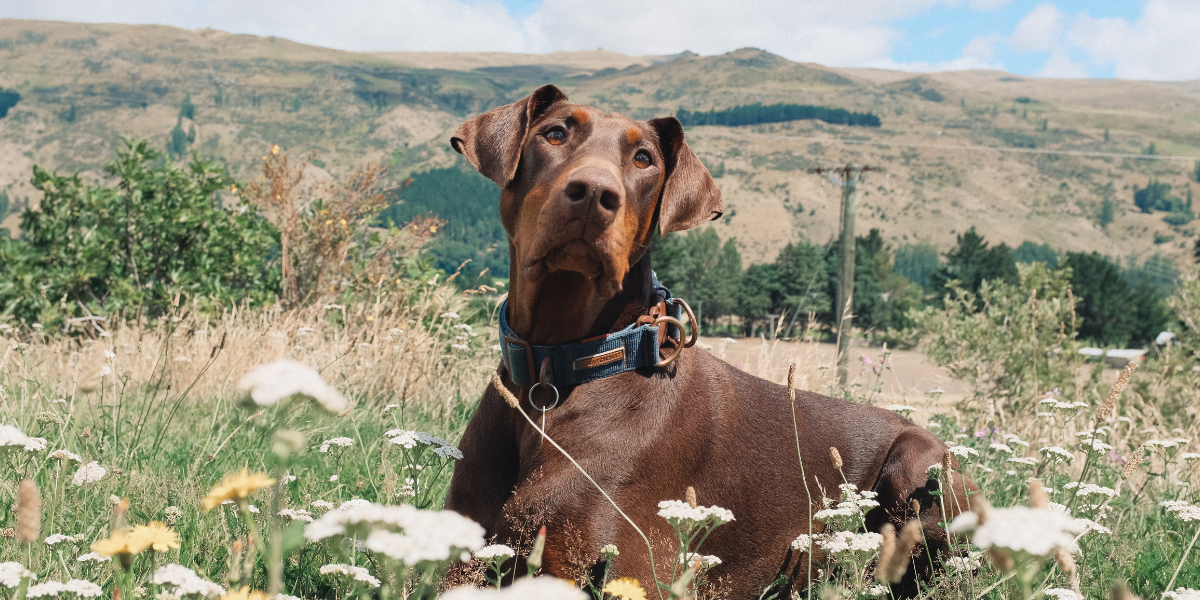
Once the collar is fastened, try to slide two fingers, ideally your index and middle finger, between the collar and your dog’s neck.
- If you cannot fit two fingers: The collar is too tight and needs to be loosened.
- If you can fit more than two fingers: The collar is too loose and your dog could easily slip their head out.
-
If they slide in with just a little bit of resistance: You have found the right fit.
For very small dogs or puppies, the two-finger rule might be a bit too much. In those cases, a single-finger fit is usually a safer bet to ensure the dog collar dimensions remain proportional to their smaller necks.
Measuring for a Collar: Step-by-Step
It is best not to guess your dog's size based on their breed alone because dogs of the same breed can have very different neck sizes. Measuring for a dog collar is the only way to guarantee a perfect fit the first time you order.
Step 1: Get the right tools
You will need a soft measuring tape, which is the kind typically used for sewing. If you do not have one handy, you can use a piece of string and then measure that string against a ruler afterwards.
Step 2: Measure the "C-Zone"
Wrap the tape around the middle of your dog’s neck. This is usually the widest part located just above the shoulders. You want to make sure the tape is snug against the fur but not digging into the skin.
Step 3: Note the measurement
Write down the circumference. You don't need to add any extra room to this number because our dog collar size chart already accounts for the necessary overlap and adjustment space.
Understanding EzyDog Sizing
Different collars serve different purposes and sometimes the fit needs to be adjusted slightly. When you are looking at the dog collar dimensions on our product pages, keep these specific styles in mind:
Neo Classic Collar:
This is made from soft and thick Neoprene so it is very forgiving on the neck. It is an excellent choice for dogs with sensitive skin. You can view the Neo Classic size guide for detailed measurements.

Double Up Collar:
This collar is built for strength and uses two D-rings to take the pressure off the buckle. Because of the dual-ring system, getting an accurate measurement is vital so that the rings align perfectly. You can check the Double Up size guide to ensure you get the right fit.

Checkmate (Martingale) Collar:
This is a gentle slip-style collar that should only be used when walking and/or training. Martingale collars are designed to gently and safely tighten when pulled, so they are great for dogs that back out of traditional collars. They are often used for training. Don't keep this collar on all day as it's not suitable for general wear.
It should be fitted so that when it is closed and pulled tight, it is the size of the dog's neck, but when it is open, it can slide comfortably over the head. You can find the Martingale collar size guide on our website.

Red Flags: 3 Signs of a Poor Fit
Even if you have followed the two-finger rule, it is worth checking your dog’s neck regularly for these specific signs:
-
Chafing or Rawness: If you see any redness or hair loss under the collar, it may be too tight or perhaps the material is too abrasive for your dog's skin type.
-
The "Coughing" Test: If your dog coughs or gags when the lead is slightly tensioned, the collar is likely sitting too high or is too narrow, which puts unnecessary pressure on the windpipe.
- The "Backwards Slip": If your dog can back out of the collar by pulling away from you, it is too loose. This is a major safety risk, especially when you are walking near busy roads.
Final Thoughts: Ready to Find the Perfect Fit?
If your dog happens to be exactly between two sizes on our chart, we generally recommend going for the larger size and then adjusting it down.
Getting groomed? Don't forget to re-adjust your dog's collar once they have been clipped as fur length and volume will affect fit.
You can speak to a member of our team if you need extra help with sizing. Visit our sizing guide for a detailed breakdown of how to measure your dog for each product.
Browse our full range and shop our dog collars, while getting your perfect size today.
Featured Products


Read more