Best Small Dog Harness UK: A Practical Guide for Small Breeds
Small dogs need a harness that is genuinely built for their proportions. A harness designed primarily for medium and large breeds, then scaled down, often sits incorrectly on a smaller frame, which is too wide across the chest, too stiff around a narrow ribcage, or poorly positioned at the shoulder. Getting the right small dog harness matters more than most owners realise, and it starts with understanding what small breeds actually need from their gear.
The small dog harness collection covers EzyDog's options for smaller breeds. Read on for a practical guide to what to look for and which harness suits which dog.
Why Small Dogs Need a Harness Rather Than a Collar
Small dogs should always be walked on a harness rather than a collar attached to a lead. This is the most important thing to get right before thinking about which harness to choose.
Toy and small breeds have proportionally narrower tracheas than larger dogs. Yorkshire Terriers, Pomeranians, Chihuahuas, Maltese, and Toy Poodles in particular are more susceptible to tracheal sensitivity, and sustained pressure on the throat from a collar-attached lead is one of the known contributing factors. Brachycephalic small breeds such as Shih Tzus, Pugs, and French Bulldogs already have compromised airways and should not be walked on a collar & lead at any point.
A harness moves all lead pressure to the chest rather than the throat. For a small dog, this is not just a comfort improvement, it is the safer choice for everyday walking.
This does not mean collars have no place. Under the Control of Dogs Order 1992, every dog in a public place must wear a collar with the owner's name and address displayed. Keep the collar on for ID tags. Use the harness for lead attachment on walks. These are two separate jobs and a well-designed setup does both.
What Makes a Good Small Dog Harness
The right small dog harness meets five specific standards. Each one matters more at a smaller scale.
1. Precise fit with fine adjustment
Standard buckle-and-slider adjustment works well enough on larger dogs where a centimetre of slack is not critical. On a small dog with a chest girth of 30cm to 40cm, the same slack represents a much larger proportion of the total circumference. A harness that is two centimetres too loose on a small breed can rotate, shift, or in some cases allow the dog to back out entirely.
Hook-and-loop closure systems, often called Velcro, give a considerably finer degree of adjustment than a buckle and slider. The FORMFIT Mesh Harness uses this approach, which is why it suits small breeds with variable chest proportions, including breeds like Bichons and Maltese whose fluffy coats can make girth measurement feel less precise than it actually is.
2. Lightweight construction that does not restrict movement
A harness that weighs even 200 grams on a 3kg dog is a much more noticeable proportion of body weight than the same harness on a 30kg dog. Lightweight materials matter at the small end of the sizing range. Heavy neoprene or thick nylon panel harnesses that suit larger breeds can feel cumbersome on a small dog and restrict the natural movement of shorter, lighter front legs.
3. No strap across the shoulder joint
The shoulder joint sits higher on many small breeds relative to their chest depth than it does on larger breeds. A harness strap that crosses the front of the shoulder restricts the forward swing of the front leg, which affects gait and causes discomfort over time. This is a more common problem on small dogs precisely because harnesses are often designed around a larger dog's proportions.
Check that the harness is above the shoulder joint and frames it on either side rather than crossing it. The dog should be able to step forward into a full stride without the harness pulling back at the shoulder.
4. Breathable materials for dogs that overheat
Small breeds with flat faces such as Shih Tzus, Pugs, French Bulldogs have reduced ability to regulate body temperature through panting. Thick or insulating harness materials make this harder. A breathable mesh construction allows air to move through the harness material rather than trapping heat against the chest, which matters on summer walks and during active exercise.
5. Secure hardware at a proportionate scale
Stainless steel D-rings resist corrosion, which is relevant for dogs that paddle or get caught in rain. On a small dog, the D-ring also needs to be proportionate such as large, heavy hardware adds unnecessary weight and can throw off the balance of a lightweight harness.
EzyDog Small Dog Harness Options
1. FORMFIT Mesh Harness
The FORMFIT Mesh Harness is EzyDog's primary recommendation for small breeds and the harness most often chosen by small dog owners across the range. It was designed specifically for small to medium breeds up to 14.5kg, and the construction reflects that focus throughout.

The 3D air mesh fabric is the defining feature. Unlike solid nylon or neoprene panels, the mesh allows constant airflow through the harness material, which keeps the dog's core temperature more stable during active walks. For flat-faced breeds and small dogs that warm up quickly during exercise, this is a practical advantage rather than a marginal one.
The hook-and-loop closure system gives a finer degree of adjustment than most standard harnesses. This is particularly useful for breeds with a coat that adds apparent bulk, such as a Bichon Frise, a Pomeranian, or a Maltese measured over a thick coat may need the closure to sit differently than the initial measurement suggests. The hook-and-loop allows the owner to find the right position exactly rather than jumping between buckle positions.
Dual stainless steel D-rings sit at the back of the harness and provide corrosion-resistant lead attachment points. The soft-edge construction around contact points reduces the risk of chafing, which is particularly relevant for long-coated breeds where friction between the harness and the fur can cause matting over time.
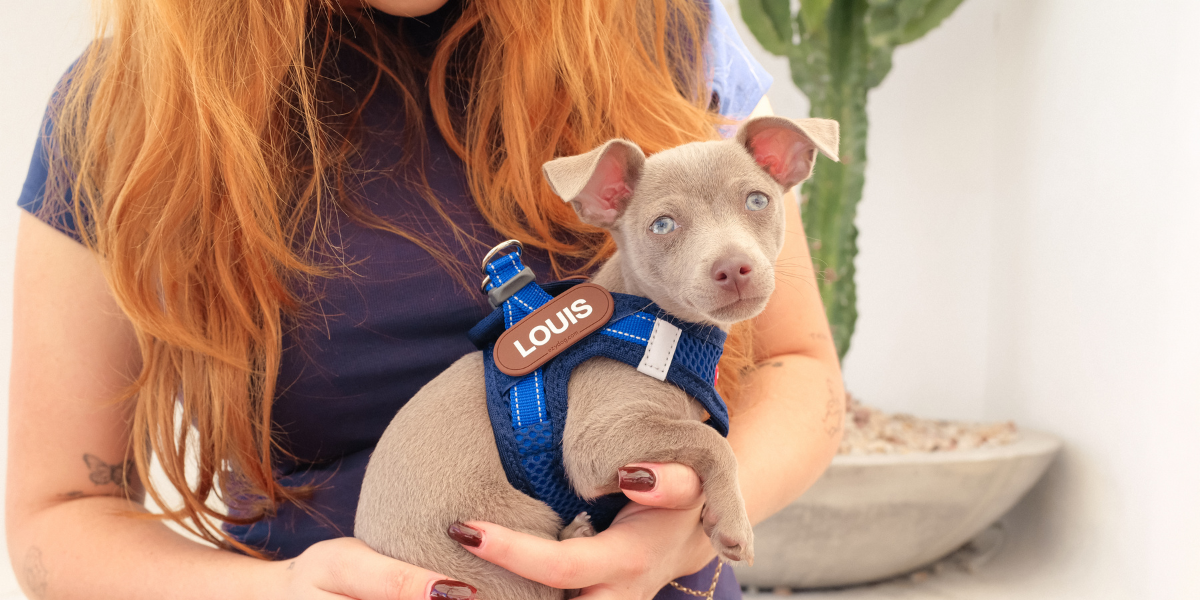
The FORMFIT also has an option to add personalised side labels with the dog's name.
Available in six colours: Green, Black, Red, Purple, Pink, and Blue. From £19.50. 283 reviews at 4.9 stars. 98% of verified buyers would recommend it.
Sizing runs from 2XS to XL, with the 2XS fitting a chest girth of 27cm to 31cm and a weight of approximately 1.5kg to 3kg. The XL fits up to 58cm girth and 14.5kg. Always measure chest girth at the widest point behind the front legs rather than relying on weight alone, as coat thickness and body shape vary significantly across small breeds.
Best for:
Shih Tzus, Maltese, Bichon Frises, Pomeranians, Chihuahuas, Cavalier King Charles Spaniels, Toy Poodles, Jack Russells, Cavapoos, Cockapoos, Pugs, Miniature Schnauzers and French Bulldogs within the weight range.
2. Chest Plate Harness
The Essential Chest Plate Harness suits small dogs whose owners want a step-in design that does not require lifting the harness over the dog's head.

The step-in approach is particularly useful for nervous or head-shy small breeds that resist gear being pulled over their face. The dog steps forward into the harness, the owner brings the sides up and clips them together, and the harness is on in seconds. For breeds like Chihuahuas and small terriers that can be particular about having things placed over their heads, this removal of the overhead step makes a genuine practical difference to the daily fitting experience.
The EVA chest plate sits comfortably without digging in at the contact points. The adjustable straps give a secure fit across a range of small dog shapes, and the lightweight construction suits the smaller frame without adding unnecessary bulk or weight.
Best for:
Head-shy or nervous small breeds, dogs that resist overhead harness fitting, and owners who want a fast, clean daily fitting process.
Small Dog Sizing Guide: Which FORMFIT Size for Which Breed
The FORMFIT Mesh Harness starts at 2XS, making it one of the few harnesses on the UK market that genuinely suits the very smallest toy breeds. Here is a practical reference for common small breeds, based on the FORMFIT size chart:
| Breed | Typical FORMFIT Size | Chest Girth Range |
|---|---|---|
| Chihuahua | 2XS to XS | 27cm to 35cm |
| Pomeranian | 2XS to XS | 27cm to 35cm |
| Yorkshire Terrier | 2XS to XS | 27cm to 35cm |
| Maltese | XS to S | 31cm to 40cm |
| Bichon Frise | XS to S | 31cm to 40cm |
| Shih Tzu | S to M | 35cm to 46cm |
| Cavalier King Charles Spaniel | S to M | 35cm to 46cm |
| Toy Poodle | XS to S | 31cm to 40cm |
| Jack Russell Terrier | S to M | 35cm to 46cm |
| French Bulldog | M to L | 40cm to 52cm |
| Pug | M to L | 40cm to 52cm |
| Miniature Schnauzer | S to M | 35cm to 46cm |
Tip: Breed examples are a guide only. Measure your dog’s chest girth before choosing a FORMFIT size.
These are typical ranges. Individual dogs vary considerably, particularly between males and females of the same breed. Always measure chest girth before ordering. If your dog falls between sizes, size up to accommodate the larger chest measurement rather than down.
How to Measure a Small Dog for a Harness
Measuring a small dog accurately requires a little patience. Small breeds are often wriggly during measuring, and the measurement must be taken with the dog standing naturally rather than sitting or being held still in an unnatural position.
Use a soft fabric tape measure. Wrap it around the widest part of the ribcage, just behind the front legs. This is the chest girth measurement and it is the primary number for sizing the FORMFIT.
The two-finger rule applies once the harness is on: you should be able to slide two fingers, laid flat, between the harness and the dog's body. Any tighter and it is too snug. Any looser and it risks shifting or rotating during a walk.
Check behind the front legs specifically after the first walk. This is where small dog harnesses most commonly cause rubbing, particularly if the chest strap sits slightly too far forward. The strap should clear the armpit area by at least two finger-widths.
For more detail, the harness size guide confirms measurements for each FORMFIT size, and the how to measure your dog for a harness guide covers the full process step by step.
Breed-Specific Notes for Small Dogs
Shih Tzus
Shih Tzus have a compact neck relative to their chest, which means a harness that fits well at the girth can sit loosely at the neck. The FORMFIT's hook-and-loop closure system handles this well because it allows independent fine-tuning rather than fixed buckle positions. Most adult Shih Tzus fit an S or M. Measure after grooming rather than when the coat is at maximum volume.
Maltese and Bichon Frises
Both breeds have long, fine coats that can mat under a harness worn for extended periods. Remove the harness when indoors and check the coat under the strap lines after walks. The FORMFIT's soft-edge construction reduces friction at contact points compared with hard-edged nylon alternatives, which helps keep matting minimal during on-lead time. Most Maltese and Bichons fit XS to S.
Pomeranians
Pomeranians have a thick double coat and a compact, rounded ribcage. The apparent chest size when measured over the coat can be larger than the actual girth underneath. Measure firmly over the coat rather than pressing through it, as the harness will sit over the full coat during walks. Most Pomeranians fit 2XS to XS depending on their individual build.
Chihuahuas
Chihuahuas vary considerably in chest size between individuals. The 2XS FORMFIT fits chest girths from 27cm, which suits most adult Chihuahuas. Some Chihuahuas have a particularly deep or round chest for their overall size, if your Chihuahua's chest measurement is toward the top of the 2XS range, order the XS to give better coverage across the ribcage.
Pugs and French Bulldogs
Both breeds have a broad, deep chest relative to their weight that can make standard sizing charts misleading. A Pug or French Bulldog may weigh less than 10kg but have a chest girth in the M or L range of the FORMFIT. Always size by chest girth, not by weight. The FORMFIT's hook-and-loop closure handles the proportionately wider chest of these breeds well.
Frequently Asked Questions
What is the best harness for a small dog in the UK?
The EzyDog FORMFIT Mesh Harness is the option we recommend for most small breeds in the UK. It was designed specifically for small to medium breeds up to 14.5kg, uses 3D air mesh for breathability, has a hook-and-loop closure for precise fit adjustment, and starts at a 2XS size that suits the smallest toy breeds. It is available from £19.50 with personalised name label options.
Should small dogs wear a harness or a collar for walks?
A harness is the recommended choice for lead walking with small dogs. Small breeds are more susceptible to throat sensitivity than larger breeds, and collar-attached leads place direct pressure on the trachea when the dog pulls. Keep a collar on for ID tags as required by the Control of Dogs Order 1992, but attach the lead to a harness for all walks.
How do I stop a small dog harness from rotating?
Rotation usually means the girth strap is too loose. Tighten the girth adjustment until the harness sits centred and does not shift during movement. Check that the neck section is also correctly adjusted. A neck section that is too loose on a small dog allows the whole harness to tip or rotate during a walk.
What size FORMFIT Mesh Harness does a Shih Tzu need?
Most adult Shih Tzus fit a Small or Medium FORMFIT, with chest girths typically between 35cm and 46cm. Measure at the widest point of the ribcage behind the front legs. Measure over the coat as the dog will wear the harness over it, and size up if your dog falls between sizes.
Can I use the FORMFIT Mesh Harness on a Pug or French Bulldog?
Yes. Both breeds are within the FORMFIT's weight range and the hook-and-loop closure handles their proportionately wider chest well. Size by chest girth rather than weight, as Pugs and French Bulldogs often have a larger chest girth than their weight would suggest. Most fit a Medium & Extra Large.
How long can a small dog wear a harness?
Use the harness for walks, car journeys, and on-lead time. Remove it when indoors. Long-coated small breeds in particular can develop matting under any harness left on for extended periods. Check the skin and coat under the strap lines after walks, particularly behind the front legs where friction is highest.
Final Thoughts
If you are looking for a small dog harness that fits properly, handles British weather, and suits breeds from Chihuahuas to French Bulldogs, the FORMFIT Mesh Harness is the option we recommend for most small breeds. For dogs whose owners prefer a step-in design, both the FORMFIT and Chest plate offer this option & removes the overhead fitting step entirely.
Browse the full small dog harness collection to compare both options alongside the full dog harnesses collection for a complete view of the EzyDog range.


Read more